
Marine Life
Raja Ampat Birds of Paradise — Topside Endemic Wildlife
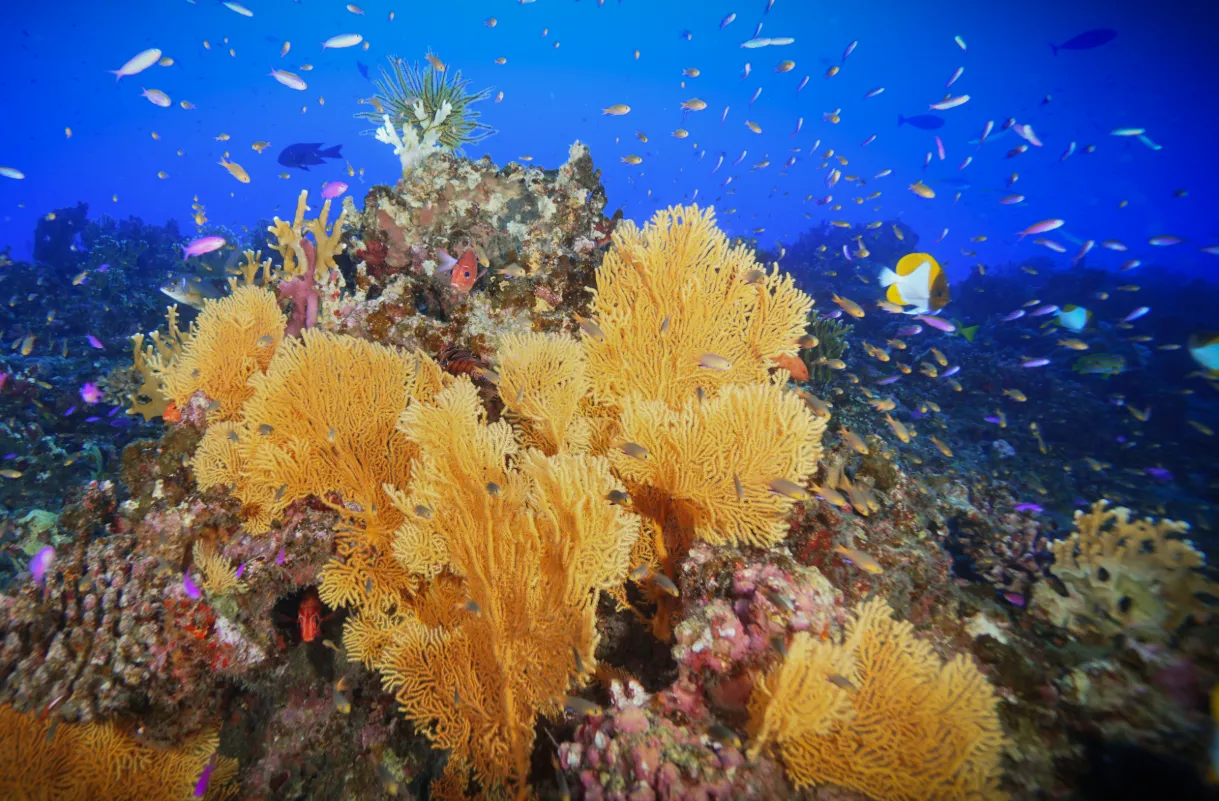
While your primary objective in Raja Ampat is undoubtedly the marine biosphere—an ecosystem comprising 75% of the world's known hard coral species across 40,000 square kilometers—a parallel display of evolutionary distinction occurs in the canopy above.
For guests of Raja Ampat Liveaboard Voyages, a land-based extension offers a precise and structured opportunity to witness this. The experience is centered on the islands of Waigeo and Batanta, requiring a pre-dawn commitment. Entry into the forest begins by 04:30, guided by local community members whose families have observed these display grounds for generations. This is a targeted excursion to observe some of the most specialized avian courtship rituals documented, a terrestrial counterpoint to the vibrant activity on reefs like Cape Kri.
01
Wilson's Bird-of-Paradise — Waigeo Endemic
The Wilson's Bird-of-Paradise, Cicinnurus respublica, is a species whose entire global population is confined to the islands of Waigeo and Batanta. Its appearance is a composition of improbable color: a bare, cobalt-blue crown crisscrossed with black skin folds, a deep scarlet mantle, and a canary-yellow cape. The male’s most distinct features are two violet tail feathers that curve outward into perfect sickles. Observing this bird requires reaching a specific display court, or lek, before sunrise. The male meticulously clears a patch of forest floor, removing every leaf and twig to create a stage. Here, he performs a complex courtship dance for visiting females. The ritual involves a series of static poses, frantic dashes, and the flashing of an iridescent emerald-green breast shield that is otherwise concealed. The accompanying vocalizations are a sequence of mechanical-sounding chirps and whirs. This is not a fleeting glimpse but a sustained observation of a specific, repeated evolutionary behavior, accessible only in this precise corner of West Papua and a primary objective for serious wildlife observers.
02
Red Bird-of-Paradise — Display Lek
In contrast to the solitary performance of the Wilson's, the Red Bird-of-Paradise, Paradisaea rubra, engages in a communal dawn ritual. This species, endemic to Waigeo, Batanta, and the nearby island of Gam, is the emblem of the Raja Ampat archipelago. Males congregate in the canopy at a traditional lek, often a single prominent tree, to compete for female attention. The performance begins with a chorus of sharp, resonant calls that carry through the still morning air. As the first light filters through the trees, the males begin their display. They hang upside down, fanning out their voluminous, deep-crimson flank plumes. Two long, wire-like tail feathers, tipped with small green discs, are twitched and vibrated with precision. The males perform a series of coordinated hops and bows, transforming the treetop into a theater of motion and sound. Witnessing multiple males displaying simultaneously provides a direct insight into the intense selective pressures that have shaped these elaborate avian characteristics over millennia. The predictability of these lek sites allows for a high probability of observation during the peak season from October to April.
03
Sapokren Village — Community Ecotourism
The primary access point for observing these species on Waigeo is the village of Sapokren. This community has become a model for sustainable ecotourism, transitioning its local economy from one historically reliant on hunting to one centered on conservation and expert-led guiding. The viability of this model was demonstrated on a global scale in 2016, when a BBC film crew, led by Sir David Attenborough, spent weeks in Sapokren filming the courtship dance of the Wilson's Bird-of-Paradise for the landmark series Planet Earth II. This event solidified the village's reputation and reinforced the economic value of its intact forest ecosystem. Today, all excursions are managed through the community. A mandatory permit system ensures that revenue directly funds local services and conservation initiatives. Visitors are accompanied by a local guide, often from a family that has stewarded the specific lek site for generations. Their knowledge of the birds' behavior, calls, and seasonal patterns is not academic but ancestral, providing an observational experience that is both authentic and effective. This structured, community-led approach ensures minimal disturbance to the wildlife while providing a direct financial incentive for its continued protection.
04
How to Add Bird-of-Paradise to Your Voyage
Integrating this terrestrial excursion into your liveaboard itinerary is a seamless process managed by our concierge team. We recommend a two-night stay on Waigeo Island either before or after your voyage aboard our Phinisi schooner. Following your arrival at Sorong (SOQ) or upon disembarkation, our ground team facilitates a transfer to the public ferry for the two-hour crossing to Waisai, the administrative capital of Raja Ampat located on Waigeo. From there, a private vehicle transfers you to a selected eco-lodge near the Sapokren community. Your stay includes two early-morning excursions to the bird-of-paradise leks. All necessary permits, community fees, and the services of a mandated local guide are arranged in advance by Raja Ampat Liveaboard Voyages. This pre-arranged package allows you to focus solely on the experience, with all logistical complexities—from transfers and accommodation to permits and guide coordination—handled to the standard our 1,240 operated voyages have established. A return transfer to Sorong for your departing flight or to join the yacht is included. This add-on requires a moderate level of fitness for the pre-dawn forest treks.
05
Other Endemic Wildlife
While the Birds of Paradise are the primary draw, the forests of Waigeo and surrounding islands host a range of other Papuan endemics. Nocturnal treks, arranged with your local guide, offer a high probability of spotting the Waigeo cuscus (Spilocuscus papuensis), a species of arboreal marsupial with distinct spotted fur. These slow-moving creatures are often found feeding on leaves in the mid-canopy. More elusive is the tree kangaroo (genus Dendrolagus), a remarkable marsupial that has adapted to life in the trees, possessing powerful hind legs for climbing and a long tail for balance. Though sightings are not guaranteed, the possibility adds a compelling dimension to forest explorations. The avifauna is also rich beyond the Paradisaeidae family. The loud, whooshing wingbeats of the Papuan Hornbill (Rhyticeros plicatus) are a common sound. These large birds, with their prominent casques, travel in pairs or small flocks and are vital seed dispersers for the rainforest. Observing these species provides a more complete understanding of the island's unique ecological composition, a system as distinct and isolated as the marine environment for which Raja Ampat is celebrated.
06
Conservation Status
The long-term survival of Raja Ampat’s endemic avifauna is a matter of active conservation management. According to the IUCN Red List of Threatened Species, the Wilson's Bird-of-Paradise (Cicinnurus respublica) is currently listed as Near Threatened, primarily due to its highly restricted range, making it vulnerable to habitat loss. The Red Bird-of-Paradise (Paradisaea rubra) is designated as Least Concern, though its population is also entirely dependent on the health of the forests on just a few islands. Nationally, all Bird-of-Paradise species are protected under Indonesian law, which strictly prohibits their hunting and trade. This legislation is reinforced at the local level by traditional customs known as sasi, which can place temporary or permanent bans on harvesting resources from specific areas. The community-based ecotourism model in villages like Sapokren provides a critical enforcement layer, creating a direct economic link between the preservation of the birds and the prosperity of the local population. By participating in these regulated excursions, guests contribute directly to this sustainable conservation framework, ensuring these species are protected for future generations.
07
Photography Brief
Photographing Birds of Paradise in their natural habitat presents a significant technical challenge. The subjects are often located high in the canopy, and the prime viewing time is during the low-light hours of dawn. A telephoto lens with a minimum focal length of 400mm is essential; a 600mm lens or a 400mm with a 1.4x teleconverter is recommended for frame-filling images. The dense forest canopy necessitates a camera body with strong high-ISO performance to achieve a sufficiently fast shutter speed (ideally 1/250s or faster) to freeze motion. A wide aperture (f/2.8-f/5.6) is critical for gathering light and isolating the subject from a complex background. A sturdy tripod or monopod is non-negotiable for stability. Set your camera to burst mode to capture the peak moments of a dynamic courtship display. Be prepared to work with your guide to find a position that offers the clearest possible line of sight, and respect their instructions to avoid disturbing the birds.
FAQ
FAQ
What is the physical difficulty of the treks?
The treks to the bird-of-paradise leks are best described as moderately difficult. The hikes begin before dawn and typically last 30 to 60 minutes. While not exceptionally long, the trails are on uneven, often muddy forest ground with some steep inclines. A good level of stability and fitness is required. The primary challenge is navigating the terrain in low light with the aid of a headlamp. Our guides set a manageable pace for all participants.
What should I pack for the land excursion?
Essential items include lightweight, long-sleeved shirts and trousers in neutral, earthy colors to protect against insects and blend in with the surroundings. Pack sturdy, waterproof walking shoes or boots with good grip. A headlamp is mandatory for the pre-dawn hike. Also bring a pair of quality binoculars (8x42 or 10x42 are ideal), insect repellent containing DEET, a reusable water bottle, and a small waterproof daypack for your camera and other essentials.
When is the best time to see the birds display?
The peak season for observing the courtship displays of the Birds of Paradise coincides directly with our primary liveaboard season, from October through April. This period aligns with the drier season in Raja Ampat, resulting in more consistent weather and heightened avian activity. The males are most active and their plumage is at its most impressive during these months as they compete for mates. Daily viewing is consistently best at dawn, between 04:30 and 06:30.
How are the guides and permits arranged?
All logistics are handled by the Raja Ampat Liveaboard Voyages concierge team as an integral part of your land-based add-on package. We secure all necessary forest entry permits and pay the required community conservation fees in advance. We also contract experienced, licensed guides from the local Sapokren community. This ensures your excursion is seamless, fully compliant with local regulations, and that your visit contributes directly and verifiably to the local economy and its conservation efforts.
Marine Life
More in Marine Life
Plan Your Raja Ampat Voyage
Our dive concierge team is ready to design your private phinisi charter. We manage all logistics — from arrival in Sorong to your departure.