Skip to content
Raja Ampat Liveaboard Diving
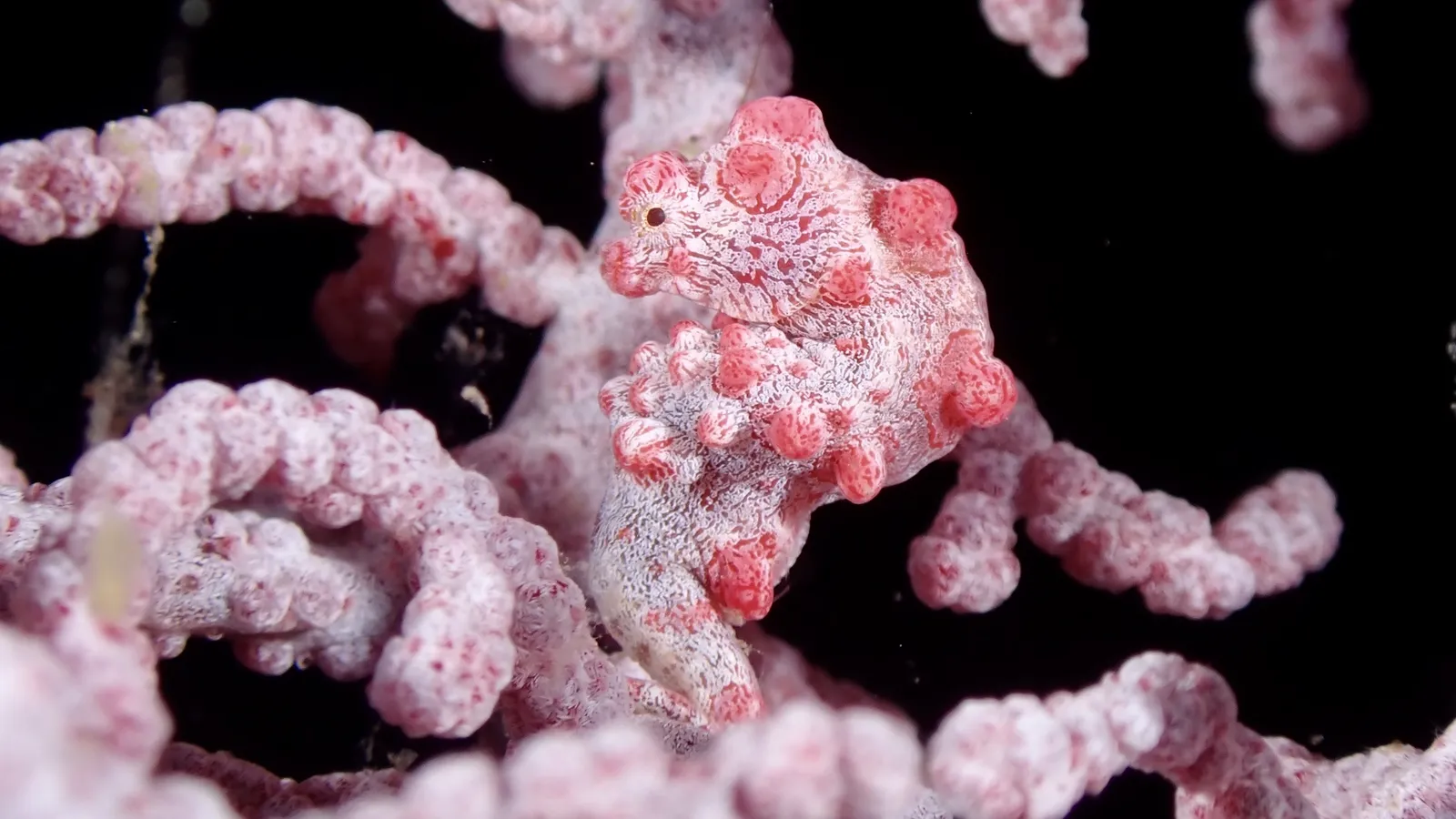
Macro reef life — Hippocampus bargibanti - Chris Spain

Marine Life

Raja Ampat Pygmy Seahorses: A Guide to Three Endemic Species

Pygmy seahorses represent a specialized group of fish from the Syngnathidae family, defined by their diminutive size—typically less than 2.5 centimeters in height.

The waters of Raja Ampat, a 40,000 km² archipelago in West Papua, are a global epicenter for the diversity of these animals. For underwater photographers and marine biology enthusiasts, observing the Raja Ampat pygmy seahorses offers a direct encounter with marine evolution's most refined camouflage. Three species are consistently documented here: Bargibant's (*Hippocampus bargibanti*), Denise's (*Hippocampus denise*), and Pontoh's (*Hippocampus pontohi*). Locating these masters of concealment requires a trained eye, specific dive knowledge, and an understanding of their unique ecology, a skillset our dive guides have honed over a decade of operations in the region.

01

The Masters of Camouflage: Identifying Raja Ampat’s Pygmy Seahorses

The core survival strategy for most pygmy seahorse species is crypsis—the ability to avoid detection by blending perfectly with a single host organism. For two of the three species found in Raja Ampat, this relationship is with a specific type of gorgonian sea fan, upon which they live their entire adult lives. They do not merely sit on the fan; their bodies have evolved to replicate its texture and color with absolute precision. This specialization makes them exceptionally difficult to locate on the visually complex reef structures that define the Raja Ampat dive sites. The third species, Pontoh's pygmy seahorse, deviates from this rule, adopting a more mobile existence among algae and hydroids, presenting a different kind of challenge for observers.

01

Hippocampus bargibanti (Bargibant's Pygmy Seahorse)

The first pygmy seahorse species to be formally described, Hippocampus bargibanti, was discovered by accident in 1969 by scientist Georges Bargibant. He was collecting specimens of Muricella gorgonians for the Nouméa aquarium and found a pair on a sea fan he had placed in his tank. At approximately 2 centimeters, its body is bulbous with a very short snout and is covered in large, rounded tubercles. These tubercles perfectly mimic the color and shape of the closed polyps of its host gorgonian. Two color morphs exist: a pale grey or purple variant with pinkish-red tubercles, found on the Muricella plectana sea fan, and a yellow variant with orange tubercles, found on Muricella paraplectana. This absolute host-specificity means that searching for H. bargibanti is, in fact, a search for a particular species of sea fan at specific depths, typically between 15 and 30 meters, on reef slopes exposed to moderate currents.
02

Hippocampus denise (Denise's Pygmy Seahorse)

Slightly smaller and more slender than its cousin, Hippocampus denise averages 1.5 centimeters in height. Its body is smoother, with far fewer and smaller tubercles, and it possesses a longer snout. This smoother skin texture allows it to blend with the surface of the gorgonians it inhabits, which have smaller, less pronounced polyps than the Muricella favored by H. bargibanti. H. denise is also less of a specialist, having been documented on at least ten different genera of gorgonians, including Annella, Echinogorgia, and Acanthogorgia. Its coloration is highly variable, often a vibrant orange or yellow, but it can adapt to match the specific color of its host fan. Divers may observe them moving between the branches of a fan, a behavior less common in the more sedentary H. bargibanti. This adaptability makes them more widely distributed throughout the archipelago, but no less challenging to spot.

03

Hippocampus pontohi (Pontoh's Pygmy Seahorse)

Pontoh's pygmy seahorse breaks the mold. Discovered in 2003 by dive guide Hence Pontoh, it is one of the so-called "free-living" species. Measuring just over 1 centimeter, it does not associate with gorgonians. Instead, it is found in tangled clumps of the green calcareous alga Halimeda or among delicate hydroid colonies on sheltered reef walls and under jetties. Its body is typically white with small yellow or orange markings on the trunk and back, and it often displays fine, reddish filaments. Unlike the gorgonian-dwellers, H. pontohi is often found in pairs or small groups, actively moving within its small territory. Locating them requires a slow, methodical search of suitable habitat, often in shallower water than the other two species. Sites like Yenbuba Jetty are noted for their resident populations.

02

Locating Pygmy Seahorses: The Role of an Expert Dive Guide

Finding a 1-centimeter animal on a vast, intricate reef system is not a matter of chance. It is a specific, learned skill. Our dive guides on every Raja Ampat liveaboard voyage possess an encyclopedic knowledge of individual dive sites, often down to the exact sea fan or patch of rubble where these creatures reside. This knowledge is accumulated over thousands of dives and is the critical factor separating a frustrating search from a successful encounter.

During dive briefings, the guide will specify the target species and its host organism. They will use a pointer to indicate the animal's location from a respectful distance, ensuring divers do not make contact with the reef or the host. Ethical interaction is central to our operational philosophy. This includes:

  • Strict No-Touch Policy: The gorgonian sea fans are delicate, living animals. A single touch can damage their tissue, leaving them vulnerable to infection and stressing the seahorses that depend on them.
  • Controlled Finning: Poor buoyancy and careless fin kicks stir up sand and silt, which can smother the polyps of the host fan and ruin visibility for observation and photography.
  • Minimal Light Exposure: Pygmy seahorses have sensitive eyes. Continuous, bright focus lights and excessive strobe flashes can cause stress, leading them to turn away or attempt to move.

For divers with a singular focus on macro life, a private charter allows for an itinerary tailored to maximize these encounters, revisiting productive sites and dedicating entire dives to the patient art of observation.

03

A Guide to Macro Photography: Documenting Raja Ampat’s Pygmies

Photographing pygmy seahorses is a technical discipline that demands specialized equipment, precise technique, and unwavering buoyancy control. The goal is to create a clear, detailed document of the animal within its environment without causing it harm.

01

Essential Equipment

Standard underwater camera setups are insufficient for this level of macro work. A successful pygmy seahorse photographer’s kit includes:

  • Camera System: A DSLR or mirrorless camera in a high-quality underwater housing provides the necessary manual control and image quality.
  • Macro Lens: A 100mm or 105mm macro lens is the industry standard. This focal length provides a 1:1 magnification ratio while allowing a comfortable working distance between the lens port and the subject, minimizing the risk of startling the animal.
  • Diopters: For the smallest subjects like H. pontohi, a "wet" diopter is essential. These are auxiliary lenses that mount to the outside of the lens port underwater, increasing magnification. A +5 to +10 diopter is often required to achieve a frame-filling image.
  • Lighting: Two external strobes are non-negotiable. They provide the light needed for small apertures and low ISOs, and their positioning can eliminate harsh shadows, revealing the seahorse's texture and detail. Wide, soft diffusers are critical to soften the light and reduce backscatter.
  • Focus Light: A dedicated, adjustable-beam focus light is needed to help the camera's autofocus system (or the photographer's eye) achieve sharp focus in the often-dim conditions where pygmies are found.
02

Camera Settings and Technique

Technical precision is key. While conditions vary, a solid starting point for pygmy seahorse photography is:

  • Aperture: A small aperture (high f-stop number), such as f/16 to f/22, is required to create a sufficient depth of field. This ensures as much of the seahorse as possible, from its snout to its tail, is in sharp focus.
  • Shutter Speed: Use the camera’s maximum flash sync speed, typically between 1/160s and 1/250s. This minimizes the influence of ambient light, allowing the strobes to be the primary light source and often creating a clean, black background that isolates the subject.
  • ISO: Set the ISO to the camera’s base level, usually 100 or 200, to ensure maximum image quality and minimize digital noise.
  • Focus: Autofocus can struggle with such small subjects. Use a single, small focus point and aim for the seahorse's eye. Many photographers prefer manual focus, using the camera's focus peaking feature to confirm sharpness.
  • Strobe Positioning: Position strobes out to the sides and slightly forward of the lens port to create modeling and texture without casting shadows from the port itself. Adjust power manually to achieve the correct exposure.

04

Prime Dive Sites for Pygmy Seahorse Encounters

While pygmy seahorses can theoretically be found on any reef with suitable host organisms, certain locations within Raja Ampat have proven to be consistently reliable. Our itineraries are designed to include these highly productive sites.

01

Central Raja Ampat: Dampier Strait

The nutrient-rich waters of the Dampier Strait fuel explosive coral growth, creating ideal habitats.

  • Yenbuba Jetty: This site is a premier location for finding the free-living H. pontohi. The reef slope and pier pilings are covered in hydroids and Halimeda algae, offering the perfect environment. The calm, clear conditions make it an excellent site for patient macro photography.
  • Mioskon Island: The sloping reefs of Mioskon are dotted with large, healthy gorgonian sea fans. Our guides have identified specific fans here that regularly host both H. bargibanti and H. denise, making it a valuable stop for those hoping to see multiple species.
  • Cape Kri: Famed for Dr. Gerald Allen’s 2012 record of 374 fish species on a single dive, the reef’s sheer biomass includes a high density of gorgonians. Amid the rush of schooling fish, a careful search of the fans on the reef slope can reveal resident pygmy seahorses.
02

Southern Raja Ampat: Misool

The southern region of Misool is renowned for its soft corals and dramatic topography. The limestone islands are undercut by water, creating overhangs and swim-throughs adorned with a profusion of sea fans. This area is a focus of our dedicated Misool expedition itineraries. Sites like Fiabacet, Boo Windows, and Nudi Rock are covered in a dense forest of gorgonians, providing extensive habitat for both H. bargibanti and H. denise. The currents here can be strong, but they are the lifeblood of these filter-feeding communities.

FAQ

Frequently Asked Questions about Raja Ampat Pygmy Seahorses

How difficult is it to find pygmy seahorses on a dive?

Without a specifically trained and experienced local dive guide, it is exceptionally difficult. Their camouflage is nearly flawless, and they do not move when approached. Our guides invest years in learning the specific locations of host gorgonians and have developed a search image that allows them to spot the seahorses. For a visiting diver, finding one unassisted is a rare occurrence. It is a specialized skill we provide on every Raja Ampat liveaboard.

What is the best time of year to see pygmy seahorses in Raja Ampat?

The seahorses are residents of their host fans and can be found throughout the year. The primary consideration is the overall diving season. The peak season for diving in Raja Ampat runs from October to April, a period characterized by calmer sea surfaces and consistently good visibility (20-40m). This makes for a more comfortable and productive diving experience, which in turn enhances opportunities for locating and photographing them.

Do I need special training to dive at sites with pygmy seahorses?

An Advanced Open Water certification is recommended for most Raja Ampat diving due to depths and potential currents. However, the most critical skill is not a certification but impeccable buoyancy control. The ability to hold your position in the water column without any hand or fin contact with the reef is mandatory to protect the delicate environment and to execute successful, ethical observation and photography.

Are pygmy seahorses endangered?

All species in the *Hippocampus* genus are listed on CITES Appendix II, which regulates their international trade. While pygmy seahorse species have not been individually assessed in detail by the IUCN, their direct reliance on fragile host organisms like gorgonians makes them highly vulnerable to localized threats such as anchor damage, destructive fishing practices, and the broader impacts of climate change on coral reef ecosystems. Responsible dive tourism is a key component of their protection.

What camera gear is essential for photographing pygmy seahorses?

A dedicated macro photography system is required. At minimum, this includes a camera with full manual controls in an underwater housing, a 100mm or 105mm macro lens, and two powerful external strobes with diffusers. For the smallest species, particularly *H. pontohi*, a high-magnification wet-mount diopter (e.g., +10) is necessary to capture a detailed, frame-filling image of the subject.

Documenting the three species of Raja Ampat pygmy seahorses is a pursuit that combines marine biology, technical diving, and photographic art. It requires patience, precision, and the expertise that comes from over a decade of dedicated operations in these waters. As a subsidiary of the Komodo Luxury group, we have facilitated 1,240 voyages, building an exceptional foundation of local knowledge. Our dive concierges are available to discuss crafting a macro-focused itinerary aboard one of our traditional Phinisi schooners. Contact us directly on WhatsApp at +62 811-3823-875 to begin planning your voyage.

Macro reef life — Hippocampus bargibanti - Chris Spain

Plan Your Raja Ampat Voyage

Our dive concierge team is ready to design your private phinisi charter. We manage all logistics — from arrival in Sorong to your departure.